
Summary
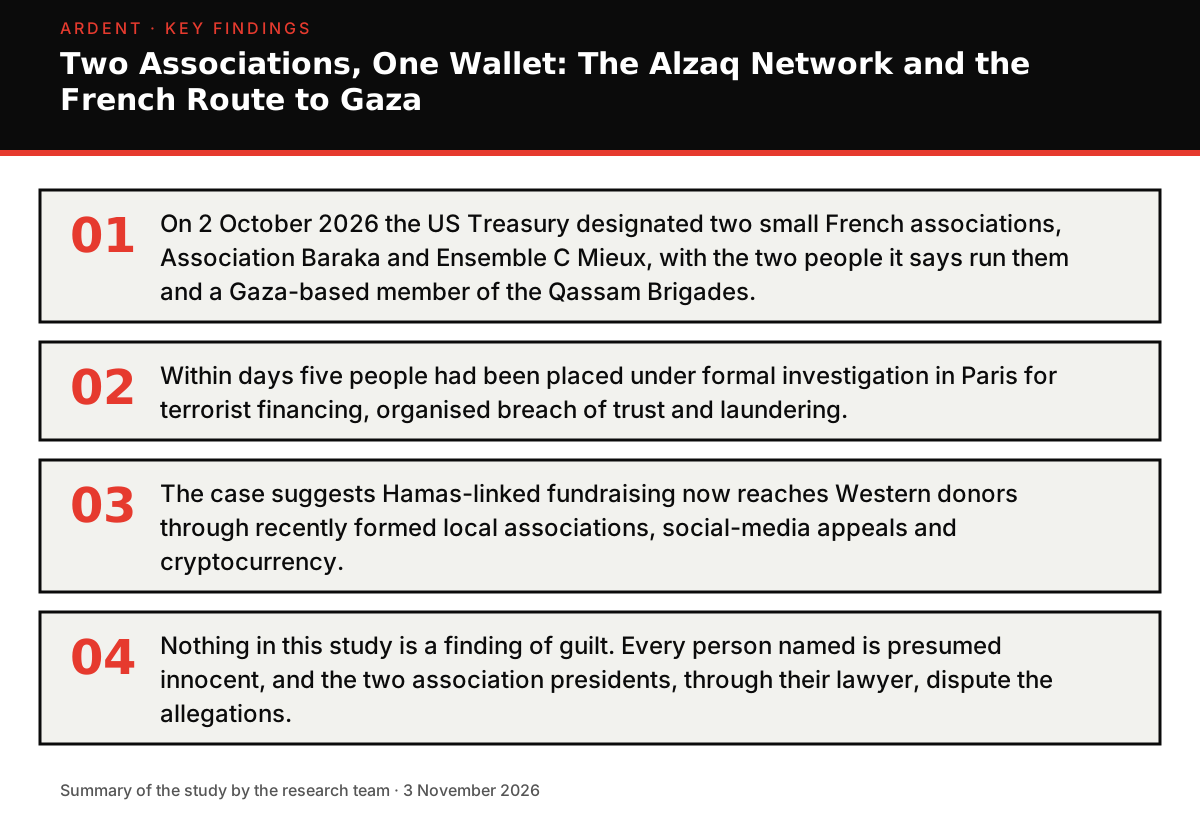
On 2 October 2026 the United States Department of the Treasury designated two small French associations, Association Baraka and Ensemble C Mieux, together with the two people it says run them and a Gaza-based member of the Izz al-Din al-Qassam Brigades, as Specially Designated Global Terrorists. The same day, the United States Department of Justice unsealed an indictment in New York and announced that three of the defendant's associates had been arrested in France by the General Directorate for Internal Security. French reports say five suspects had been taken into custody on 29 September. Within days five people had been placed under formal investigation in Paris for terrorist financing, organised breach of trust and laundering.
This study reads the public record of that operation closely. It sets out what each authority has actually said, separates official allegation from judicial finding, and draws out what the case suggests about how Hamas-linked fundraising now reaches Western donors: not through large, long-established charities, but through recently formed local associations, social-media appeals and cryptocurrency. Nothing in this study is a finding of guilt. Every person named is presumed innocent, and the two association presidents, through their lawyer, dispute the allegations.
1. Why this case matters
The research team's earlier work concentrated on the large structures of the Islamist financial world: state designations of Muslim Brotherhood branches, statutory inquiries into substantial British charities and EU-level sanctions. The October operation points in the other direction. Its targets are two French associations established in 2023 and 2024, run, according to the United States government, by two individuals in the Gironde and the Loire, and connected to a single fundraiser in Gaza.
The scale is modest by the standards of state-sponsored finance. The sums alleged are between $1.7 million and $2 million, on US government figures, over some six years (US Department of the Treasury 2026d; US Attorney's Office, Southern District of New York 2026). Yet the case is significant for three reasons. First, it is one of the few recent actions in which United States and French authorities acted in close coordination against the same network, which allows the two public records to be read side by side. Second, it is the clearest public description so far of a model that combines a French associative wrapper, crowdfunding through social media and cryptocurrency transfers. Third, the discrepancies between the various official accounts, which are small but real, illustrate how carefully such cases must be reported.
2. The public record
2.1 The Treasury designations
The Office of Foreign Assets Control announced on 2 October 2026 that it had designated "a member of Hamas's military wing, along with two France-based individuals and two affiliated entities that provide critical financing to Hamas" (US Department of the Treasury 2026d). All five designations were made under Executive Order 13224, the core United States counter-terrorism sanctions authority.
According to the Treasury, Saleem Abdallah Saleem al-Zaq is "a Gaza-based battalion deputy in the Hamas military wing who oversees a financial network that has used various money services businesses and cryptocurrency wallets to transfer significant funds to the Hamas Al-Qassam Brigades". The Treasury adds that he "also served as a photographer in the Hamas media office" (US Department of the Treasury 2026d).
The Treasury says that Faouzi Barika and Amel Oualid "operate from France, where they run purported charities ostensibly to raise money for humanitarian purposes to aid Gazan civilians", and that "in reality, they partner with al-Zaq to raise and transfer money directly to him, which al-Zaq in turn funnels to Hamas". It states that over "a six-year period from 2020–2026" the three "collected more than $2 million for Hamas, of which $1.5 million was collected after the October 7, 2023 Hamas attack on Israel", and that Barika and Oualid "sent hundreds of thousands of dollars in cryptocurrency to al-Zaq" (US Department of the Treasury 2026d).
On the two associations, the Treasury says that Barika "jointly established France-based Association Baraka with al-Zaq" and that Oualid "established France-based Ensemble C Mieux". The associations are designated for "being owned, controlled, or directed by" Barika and Oualid respectively (US Department of the Treasury 2026d).
The accompanying entry on the Specially Designated Nationals list gives further detail. It records Association Baraka with an "Organization Established Date" of 13 October 2023 and Ensemble C Mieux with an established date of 1 July 2024; both are listed with the "Target Type" of "Charity or Nonprofit Organization" and a French registration number in the "W" series used for associations (Office of Foreign Assets Control 2026).
2.2 The Justice Department indictment
The United States Attorney's Office for the Southern District of New York announced on the same day "the unsealing of an Indictment charging SALEEM ALZAQ", together with arrests of three people in the United States, and stated that "in a coordinated law enforcement operation in France, three of ALZAQ's associates, FAOUZI BARIKA, AMEL OUALID, and NORDINE BARIKA, were arrested by the French General Directorate for Internal Security" (US Attorney's Office, Southern District of New York 2026).
The prosecutors' account differs from the Treasury's in emphasis and in one figure. The Justice Department states that "since January 2020, ALZAQ has collected more than $1.7 million through purported charitable campaigns" and that his "associates in France, BARIKA, AMEL OUALID, and others assisted ALZAQ in collecting and transferring money raised for Hamas" (US Attorney's Office, Southern District of New York 2026). The Treasury says the three designated individuals collected "more than $2 million" between 2020 and 2026 (US Department of the Treasury 2026d). The Justice Department says Mr Alzaq collected "more than $1.7 million" through purported charitable campaigns since January 2020 (US Attorney's Office, Southern District of New York 2026). The New York Police Department commissioner, in the same release, refers to "more than $2 million being funneled to Hamas", and the US Attorney to "more than a million dollars". No public document reconciles these figures, and this study does not attempt to.
Mr Alzaq is charged with conspiring to provide material support to Hamas, conspiring to violate the International Emergency Economic Powers Act, conspiring to commit money laundering and conspiring to defraud the United States. The release states plainly that "the charges contained in the Indictments and Complaints are merely accusations, and the defendants are presumed innocent unless and until proven guilty", and adds in a footnote that "every fact described therein should be treated as an allegation" (US Attorney's Office, Southern District of New York 2026). The research team has not been able to examine the redacted indictment attached to the release and relies on the release alone.
2.3 The French judicial proceedings
The French side of the record comes from the press, which in turn relies on the National Anti-Terrorism Prosecutor's Office (Parquet national antiterroriste) and judicial sources. Radio France Internationale reported on 3 October 2026 that five suspects were first taken into custody on Tuesday 29 September by investigators of the General Directorate for Internal Security, and that a judicial investigation was opened on the Friday for "financement d'entreprise terroriste, en l'occurrence le Hamas", "abus de confiance en bande organisée" and "blanchiment d'abus de confiance en bande organisée en relation avec une entreprise terroriste" (RFI 2026).
Ouest-France, citing a judicial source quoted by Agence France-Presse, reported that the preliminary inquiry (enquête préliminaire) had been opened by the National Anti-Terrorism Prosecutor's Office on 21 April; that Faouzi B. was remanded in custody in Paris on Tuesday 6 October 2026 after a deferred hearing he had requested; and that Amel O. was placed under judicial supervision, as were Nordine B., whom the newspaper describes as Faouzi B.'s brother, and two other people whose identities were not disclosed (Ouest-France 2026).
The National Anti-Terrorism Prosecutor's Office made a statement on Saturday 3 October 2026, reported by Agence France-Presse and carried by Dernières Nouvelles d'Alsace. It confirmed the three offences and stated that the suspects are alleged, "par le truchement de deux associations, [d'avoir] fait parvenir des fonds à un tiers, collecteur de fonds pour le compte du Hamas", adding "ce qu'ils contestent". The office did not disclose the suspects' identities. The same report confirms that the preliminary inquiry was opened on 21 April and that the judicial investigation (information judiciaire) followed the custody period (DNA 2026); Radio France Internationale dates its opening to Friday 2 October (RFI 2026).
Two points follow. The French timeline begins with a preliminary inquiry in April 2026, more than five months before the American announcements, which suggests that the operation was not simply a French reaction to a United States listing. And the French charges include organised breach of trust, which frames donors as potential victims as well as framing the money's alleged destination as criminal.
2.4 The response of those named
According to Radio France Internationale, the two association presidents contest the alleged transfers through their lawyer. Mr Barika's lawyer, Lucie Simon, told Agence France-Presse: "Mon client a participé à des collectes de fonds dans un but exclusivement humanitaire, une détention serait scandaleuse" (RFI 2026). Ouest-France reported that, when contacted after the remand decision, she did not wish to comment (Ouest-France 2026). Ms Oualid's lawyer, who asked not to be named, told Agence France-Presse: "Ma cliente est engagée dans l'humanitaire, au soutien d'une population civile victime d'un génocide à Gaza, elle n'a aucun lien avec le Hamas" (DNA 2026). The prosecutor's office itself records that the suspects contest the facts (DNA 2026). The research team has found no public statement by either association. These denials should be given equal prominence to the allegations in any published version.
3. Allegations and findings: what is established
Because this study deals with named people who have not been tried, it is worth being precise about what the public record does and does not establish.
Established as fact (public acts of authorities):
- On 2 October 2026 the Office of Foreign Assets Control added Mr al-Zaq, Mr Barika, Ms Oualid, Association Baraka and Ensemble C Mieux to the Specially Designated Nationals list (Office of Foreign Assets Control 2026).
- On the same day the Southern District of New York unsealed an indictment against Mr Alzaq (US Attorney's Office, Southern District of New York 2026).
- In France, five people were placed under formal investigation (mis en examen) for the offences listed in section 2.3; one was remanded in custody and four placed under judicial supervision (RFI 2026; Ouest-France 2026).
Allegations (not tested in any court):
- That Mr al-Zaq is a battalion deputy in the al-Qassam Brigades and that the funds he collected went to Hamas.
- That the French associations were used to raise money for Mr al-Zaq and, through him, Hamas.
- That "more than $2 million" was collected by the three designated individuals (Treasury), or "more than $1.7 million" by Mr Alzaq (Justice Department).
- That hundreds of thousands of dollars were sent by cryptocurrency.
An administrative designation by the Treasury is not a criminal conviction. It is a blocking measure taken on an administrative record, and the Treasury itself notes that persons may petition for removal from the list (US Department of the Treasury 2026d). The French mise en examen signifies that investigating judges consider there to be serious or corroborating indications, but it is not a finding of guilt.
4. Reading the model
Setting aside the question of guilt, which is for the courts, the public description of the network is analytically useful. It describes a fundraising architecture with four features.
4.1 A small, recent associative wrapper
The two associations were, on the Treasury's own data, formed on 13 October 2023 and 1 July 2024 (Office of Foreign Assets Control 2026). Yet the alleged fundraising runs from 2020. If the Treasury and the Justice Department are right, the associations were therefore not the origin of the network but a later layer added to an existing practice of personal fundraising. The first was formed within a week of the 7 October 2023 attack, at a moment of acute public concern about Gaza.
The policy implication is uncomfortable. A French association under the 1901 law can be declared quickly and cheaply. It confers a public identity and, often, a bank account, but it is not subject to anything like the reporting obligations of a large registered charity in England and Wales. Lightweight vehicles of this kind are well suited to sudden waves of humanitarian giving, which is precisely why they are attractive to anyone seeking to divert such giving.
4.2 Personal social-media promotion
The Treasury states that Mr al-Zaq "advertised both Barika's and Oualid's fundraising accounts on his own social media accounts" (US Department of the Treasury 2026d). The Justice Department describes his campaigns as "purportedly providing humanitarian aid to people in Gaza" (US Attorney's Office, Southern District of New York 2026). The model, as alleged, is personality-led: an individual in Gaza with an online audience, European partners who give the appeal a legal home, and donors who may never know who sits at the end of the chain.
4.3 Cryptocurrency as the bridge
The single most important operational claim is that "hundreds of thousands of dollars" moved from France to Gaza in cryptocurrency (US Department of the Treasury 2026d). The Treasury also describes Mr al-Zaq's network as using "various money services businesses and cryptocurrency wallets". Cryptocurrency removes the need for a correspondent bank willing to send money into Gaza, and it moves value directly from a European wallet to a recipient. It also leaves a permanent public ledger, which is one reason such networks can later be reconstructed by investigators.
4.4 Donors in more than one country
The Justice Department release describes contributions from the United States: two men in Louisiana allegedly contributed about 94,000 and 11,000 dollars respectively, and a man in Florida allegedly provided "almost $50,000" (US Attorney's Office, Southern District of New York 2026). These, too, are allegations. They show, however, that the alleged network did not draw only on French donors; the French associations were one channel among several.
5. The wider pattern of 2026 designations
The October action is the latest in a series of 2026 Treasury designations that target the charitable sector specifically, and which the desk has not previously examined.
- 21 January 2026. The Treasury designated six Gaza-based organisations, including Waed Society Gaza, Al-Nur Society Gaza, Qawafil Society Gaza, Al-Falah Society Gaza, Merciful Hands Gaza and Al-Salameh Society Gaza, which it says are "organized by, and integrated into, Hamas's military wing", relying on "documentary evidence taken from Hamas offices after October 7, 2023". It also designated the Popular Conference for Palestinians Abroad, which it says is "clandestinely acting on behalf of Hamas", and a United Kingdom-based official of that body (US Department of the Treasury 2026a).
- 12 March 2026. The Treasury designated three Türkiye-based nonprofit organisations and one Indonesia-based charity, and stated that Hayat Yolu "has been identified as an operational headquarters, banking and financial hub for the Muslim Brotherhood" (US Department of the Treasury 2026b).
- 23 July 2026. The Treasury designated a United Kingdom-based person it describes as "Secretary General of the Muslim Brotherhood General Secretariat", stating that he "supported the fundraising for U.S.-designated institutions like Filistin Vakfi and Hayat Yolu", together with an Indonesia-based and a Gaza-based charity and a Türkiye-based money exchange (US Department of the Treasury 2026c).
Read together, these releases describe a layered structure in the Treasury's own words: a "network of nonprofit organizations … ultimately channel assets to local charities in Gaza that are controlled by Hamas" (US Department of the Treasury 2026b), with Muslim Brotherhood figures and institutions alleged to sit in the fundraising tier. The July release speaks of "a multi‑layered typology in which Muslim Brotherhood affiliates and Hamas‑directed front organizations operate transnational fundraising channels" (US Department of the Treasury 2026c).
The October case fits the lower end of that typology. Unlike the Türkiye-based bodies or the alleged Brotherhood officials, the French associations are not described by the Treasury as Brotherhood institutions, and the research team has found no public source connecting them to the Muslim Brotherhood. It would be wrong to imply such a link. What the case does show is the retail end of a system the Treasury has spent 2026 mapping from the top: individual fundraisers, short-lived associations and digital payment rails.
6. What remains unknown
The public record leaves several questions open, and an investigative follow-up should treat them as leads, not conclusions.
- The totals. Why does the Treasury cite "more than $2 million" (three individuals, 2020–2026) while the Justice Department cites "more than $1.7 million" (Mr Alzaq, since January 2020)? The figures may measure different things, but no public document says so.
- The French asset position. A United States designation does not by itself freeze assets in France. The research team searched the French Treasury's national asset-freeze register (publication of 30 October 2026, 8,215 entries) on 3 November 2026 and found no entry for Association Baraka, Ensemble C Mieux, Faouzi Barika, Amel Oualid (or the alias Bouchekif), Saleem al-Zaq/Alzaq or the Saint-André-de-Cubzac address (Direction générale du Trésor 2026). The register does list "Association Barakacity" and "BARAKACITY Limited"; these are separate bodies, no source consulted connects them with Association Baraka, and the two names must not be confused. The search should be repeated on the publication date.
- The French charging documents. The French offences are known only through press reports quoting the prosecutor and judicial sources. No French court document has been examined.
- Donor awareness. The French charge of organised breach of trust implies that at least some donors may have been deceived. The degree to which donors knew the alleged destination of their money is unknown and will matter greatly for how the case is reported.
- Platform role. The public documents do not name the social-media or crowdfunding platforms used, nor the cryptocurrency exchanges or wallets involved.
7. Implications
For Western governments, the case argues for three shifts in emphasis.
First, regulators should watch the newly formed, not only the large. Most public attention, including the research team's own, has gone to substantial charities with large incomes. On the official account, the money in this case moved through associations that were at most three years old.
Second, coordination matters more than unilateral listing. The October operation combined a Treasury designation, a United States indictment and French arrests following a preliminary inquiry the National Anti-Terrorism Prosecutor's Office had opened on 21 April 2026, more than five months earlier. Each instrument did something the others could not: the designation cut the targets off from the dollar system, the indictment created a prosecutable case in the United States, and the French investigation allowed arrests where the people actually live.
Third, cryptocurrency should be treated as a charity-sector risk, not only a financial-sector one. Guidance to charities and donors still focuses largely on banking and cash. The model alleged here bypasses both.
8. Conclusion
The Alzaq case is not, on the public record, a story about the Muslim Brotherhood's institutions, and this study does not present it as one. It is a story about the edge of the system the Treasury describes: the point at which the sympathy of ordinary donors is allegedly converted, through a small association and a digital wallet, into funds for an armed group. The courts in New York and Paris will decide what happened. In the meantime, the case offers a rare, two-jurisdiction view of how such networks are said to work, and a reminder that the most consequential gaps in counter-terrorist-financing policy may lie not in the large charities that regulators already watch, but in the small ones they have barely had time to notice.
References
Direction générale du Trésor. 2026. Registre national des gels (JSON publication of 30 October 2026). Searched 3 November 2026. https://gels-avoirs.dgtresor.gouv.fr/.
DNA (Dernières Nouvelles d'Alsace). 2026. "Soupçons de financement du Hamas : trois des cinq mis en examen sur une liste noire américaine." With AFP, 3 October 2026. https://www.dna.fr/faits-divers-justice/2026/10/03/soupcons-de-financement-du-hamas-trois-des-cinq-mis-en-examen-sur-une-liste-noire-americaine.
Office of Foreign Assets Control. 2026. "Counter Terrorism Designations." Recent Actions, 2 October 2026. https://ofac.treasury.gov/recent-actions/20261002.
Ouest-France. 2026. "Un président d'association écroué à Paris pour soupçon de financement du Hamas." Ouest-France, 7 October 2026. https://www.ouest-france.fr/societe/justice/un-president-dassociation-ecroue-a-paris-pour-soupcon-de-financement-du-hamas-30a24f70-c1d1-11f1-97ef-829bf84bf59f.
RFI. 2026. "Soupçon de financement du Hamas via l'humanitaire: cinq personnes inculpées en France." Radio France Internationale, 3 October 2026. https://www.rfi.fr/fr/moyen-orient/20261003-soup%C3%A7on-de-financement-du-hamas-via-l-humanitaire-cinq-personnes-inculp%C3%A9es-en-france.
US Attorney's Office, Southern District of New York. 2026. "Coordinated Arrests and Charges Dismantle Hamas Terror Finance Network Raising Funds from the United States." Press Release 26-281, 2 October 2026. https://www.justice.gov/usao-sdny/pr/coordinated-arrests-and-charges-dismantle-hamas-terror-finance-network-raising-funds.
US Department of the Treasury. 2026a. "Treasury Exposes and Disrupts Hamas's Covert Support Network." Press release SB0368, 21 January 2026. https://home.treasury.gov/news/press-releases/sb0368.
US Department of the Treasury. 2026b. "Treasury Continues to Disrupt Hamas' Sham Charity Network as the Group Refuses to Disarm." Press release SB0415, 12 March 2026. https://home.treasury.gov/news/press-releases/sb0415.
US Department of the Treasury. 2026c. "Treasury Disrupts Muslim Brotherhood and Hamas Financial Networks." Press release SB0572, 23 July 2026. https://home.treasury.gov/news/press-releases/sb0572.
US Department of the Treasury. 2026d. "Treasury Dismantles Major Hamas Financing Network." Press release SB0647, 2 October 2026. https://home.treasury.gov/news/press-releases/sb0647.